When Crisis Hits, the Search to Send Money Home Spikes

TopMoneyCompare analysed 10 years of Google Trends data for “send money to [country]” searches.

From earthquakes and floods to war and political unrest, the pattern is clear: when families face crisis at home, people abroad start looking for ways to send money back.

May 27, 2026
18 min read
TopMoneyCompare analysed 10 years of Google Trends data to explore how wars, natural disasters, political unrest, and economic uncertainty trigger spikes in international money transfer and remittance searches worldwide.

Remittance Statistics: Highlights

Over the past decade, major global shocks repeatedly coincided with sharp rises in searches for "send money to [country]".
The clearest spikes followed sudden, high-impact events, especially wars, earthquakes, floods and political unrest.
In the country examples, search interest often rose immediately after the triggering event, suggesting a fast diaspora response.
The strangest pattern came on 9 November 2025, when searches rose across many destinations at once, averaging 12.1x above baseline.
The strongest fit for that synchronised surge appears to be US immigration and deportation anxiety, though the data shows correlation rather than proof.

Crises Leave a Financial Search Trail

Wars, earthquakes, floods and political unrest are usually measured in visible damage: lives lost, homes destroyed, people displaced and economies disrupted.

But they also leave another kind of trace. When a crisis hits, people abroad often start looking for ways to send money back home.

That behaviour is not always captured in official remittance figures, which can take months to appear. Search data moves faster. It can show the first wave of concern from families, friends and diaspora communities trying to respond in real time.

TopMoneyCompare began looking into this after noticing uneven interest across different money transfer routes and periods in its own search data. Some destinations appeared to attract sudden bursts of attention, while others stayed comparatively stable.

To test whether those shifts were isolated quirks or part of a wider pattern, we analysed 10 years of Google Trends data for searches in the format “send money to [country]”.

The pattern was striking. Across wars, natural disasters and political shocks, some of the clearest spikes appeared immediately after major real-world events, suggesting that remittance-related search behaviour can act as an early signal of financial urgency abroad.

How Global Events Trigger Remittance Interest

The ranking chart below shows the clearest spikes we found across the study.
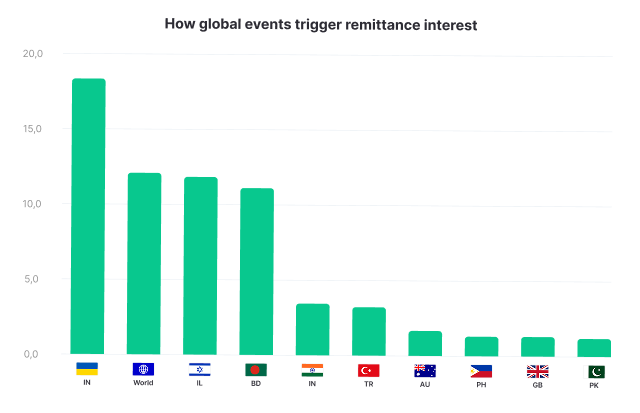
Each bar shows the size of the jump in search interest around a major event, measured against that country or event’s own baseline. It does not show how much money was sent, or how one country compares with another in total remittance volume.

That distinction matters. A smaller remittance market can still show a sharp search spike if interest suddenly moves from low to high. A large corridor can look less dramatic if searches were already consistently high.

The point is not that every crisis produces the same response. It is that the same broad pattern appears across very different types of shock.

War in Ukraine. The 7 October attacks in Israel. Political unrest in Bangladesh. Flooding in India and Pakistan. The Turkey earthquake. Super Typhoon Rai in the Philippines. Australia’s Black Summer bushfires. Even Brexit appears as a smaller, more financial-market-driven outlier.

Different events, different countries, different communities.

But in each case, the search to send money home rose when uncertainty did.

The Crises Behind the Spikes

The individual country charts show the same pattern from different angles. These were not normal seasonal lifts or slow changes in interest. In each case, a sudden event was followed by a visible jump in people searching how to send money to that country.
1 / 9
Ukraine: Full-scale invasion
February 2022
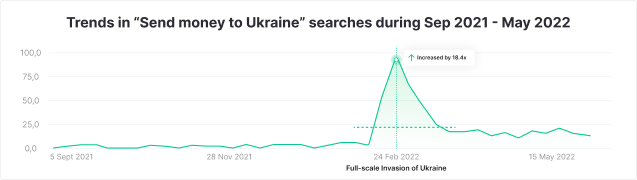
Trends in "Send money to Ukraine" searches during Sep 2021 – May 2022
Ukraine is the clearest standout in the country data. Russia's full-scale invasion in February 2022 was the largest assault on a European state since the Second World War, and more than 1 million people fled the country in just seven days. Search interest in sending money to Ukraine rose sharply in the same window, peaking at 18.4x above its baseline.
2 / 9
Israel: War in Gaza
October 2023
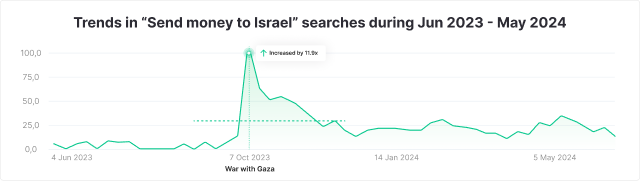
Trends in "Send money to Israel" searches during Jun 2023 – May 2024
The 7 October attacks produced another major outlier. Around 1,200 people were killed and 251 were taken hostage, while Israel called up about 360,000 reservists in its largest mobilisation since 1973. Searches for sending money to Israel rose almost immediately, reaching 11.9x above baseline. The chart shows how quickly a security shock can turn into financial search behaviour abroad.
3 / 9
Bangladesh: Political crisis and mass demonstrations
October 2025
Trends in "Send money to Bangladesh" searches during Dec 2024 – Oct 2025
Bangladesh shows the same pattern in a political crisis rather than a war or natural disaster. A UN report said up to 1,400 people may have been killed in the 2024 uprising that led into the current political crisis. In October 2025, police used batons, tear gas and stun grenades outside parliament. Search interest for sending money to Bangladesh then rose to 11.2x above baseline.
4 / 9
Turkey: Earthquake
February 2023
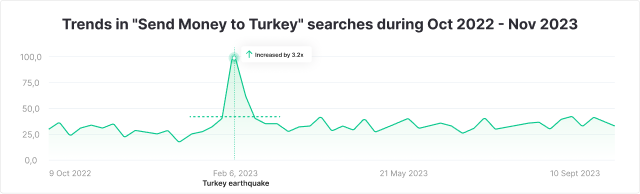
Trends in "Send Money to Turkey" searches during Oct 2022 – Nov 2023
Turkey's February 2023 earthquake was a sudden, devastating trigger. Two massive quakes, measured at 7.8 and 7.5, struck around nine hours apart. More than 50,000 people were killed in Türkiye and more than 3.3 million were displaced. In the chart, searches for sending money to Turkey jump around the event, rising 3.2x above baseline.
5 / 9
India: Flooding
October 2025
Trends in "Send money to India" searches during Dec 2024 – Oct 2025
India's spike came after extreme rainfall and flooding in October 2025. More than 300mm of rain fell in just 12 hours, triggering nearly 400 landslides across Darjeeling district. At least 24 people were killed, bridges collapsed and tourists were stranded. The chart shows a sharp rise in searches to send money to India at the same point, reaching 3.4x above baseline.
6 / 9
Australia: Bushfire season
December 2019
Trends in "Send money to Australia" searches during Aug 2019 – May 2020
Australia's Black Summer bushfires produced a smaller but still visible spike. Thirty-three people died, more than 3,000 homes were destroyed, and smoke plumes travelled around the globe. Canberra's air quality was rated the worst in the world on 1 January 2020. Search interest rose around the peak of the disaster, reaching 1.6x above baseline.
7 / 9
Philippines: Super Typhoon Rai
December 2021
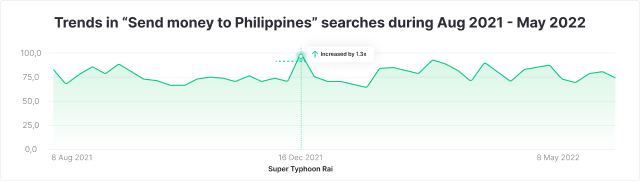
Trends in "Send money to Philippines" searches during Aug 2021 – May 2022
Super Typhoon Rai intensified into a Category 5 storm just hours before landfall in December 2021. It crossed the Philippines through nine separate landfalls, damaging more than 2.1 million homes and affecting 11.9 million people. Searches for sending money to the Philippines rose around the typhoon's landfall window, reaching 1.3x above baseline.
8 / 9
United Kingdom: Brexit referendum
June 2016
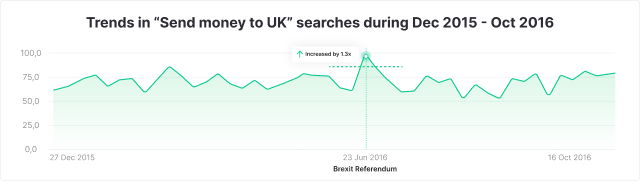
Trends in "Send money to UK" searches during Dec 2015 – Oct 2016
The UK is a different kind of case. Brexit was not a natural disaster or conflict, but it did create a financial shock. More than 33.5 million people voted, Leave won 51.9% to 48.1%, and sterling fell to a 31-year low within hours. The search spike here reflects uncertainty rather than emergency relief, reaching 1.3x above baseline.
9 / 9
Pakistan: Floods
June 2022
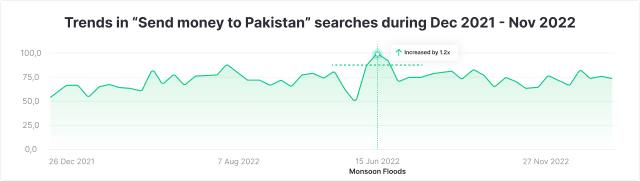
Trends in "Send money to Pakistan" searches during Dec 2021 – Nov 2022
Pakistan's 2022 floods affected 33 million people, with roughly one-third of the country under water at the peak. Some provinces saw 700% more rain than average, and floodwaters formed a vast stagnant lake visible from space. Searches for sending money to Pakistan rose around the disaster, reaching 1.2x above baseline, though less sharply than the largest crisis spikes.

The Shared Pattern Across Events

The case studies do not all point to the same kind of crisis.

Ukraine and Israel were conflict shocks. Turkey, Pakistan, India, the Philippines and Australia were natural disasters. Bangladesh was political unrest. Brexit was a financial and political shock rather than a humanitarian emergency.

But the pattern underneath is similar.

The clearest spikes followed sudden events that created fear, disruption or immediate financial pressure. When the event was sharp enough, search interest moved quickly too. People abroad were not waiting for official figures or long-term economic data. They were looking for practical ways to help.

That is what makes the signal useful. Google Trends does not show how much money was actually sent, and it cannot prove that every search turned into a transfer. But it does show a fast, public layer of diaspora response.

Before remittance figures catch up, search behaviour can show where stress is building.

The Global Synchronised Surge: 9 November 2025

Most of the spikes in this study have an obvious anchor.

The 9 November 2025 spike was different.
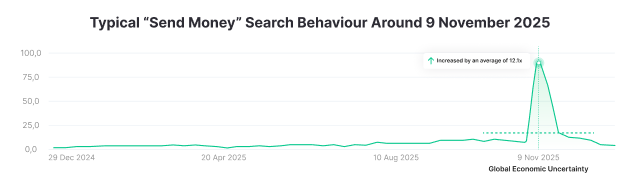
This was not a single-country crisis. Search interest rose across many destinations at once, averaging 12.1x above baseline. That makes it the strangest pattern in the study: a synchronised remittance-search surge without one clear disaster, war or election to explain it.

The strongest fit is immigration anxiety in the US.

By late 2025, US immigration enforcement had intensified sharply. Reuters reported that the number of people in ICE detention had risen by around 70% since Trump took office, reaching almost 66,000 in November 2025. Large migrant groups were also facing renewed legal uncertainty, with Temporary Protected Status changes affecting or threatening people from countries including Venezuela, Haiti, Honduras and Nicaragua.

There were also signs that deportation routes were expanding. Guatemala agreed to accept 40% more deportation flights from the US, including people of other nationalities, after talks with US Secretary of State Marco Rubio. Around the same period, remittances into parts of Latin America were already rising: Honduras was up 25%, Guatemala 20% and Nicaragua 22% over comparable periods, according to reporting originally published by The New York Times.

That does not prove why searches spiked on 9 November. But it does make immigration and deportation anxiety the most convincing explanation: migrants fearing detention, deportation or loss of access to US-held savings may have had a clear reason to look for ways to move money abroad quickly.

Other explanations fit less well.

The new US remittance tax, applying to certain cash or physical-instrument transfers, was due to begin on 1 January 2026, but it was a scheduled policy change, not a sudden one-day trigger. US-China trade tensions also added uncertainty in late 2025, but they were not directly linked to household remittance behaviour.

Local crises, such as the India floods or Bangladesh unrest, were serious but staggered. Seasonality is also too broad an answer: November and December are normally active months, but normal seasonality does not explain a sharp early-November spike across many countries in one year.

Conclusion

The pattern is not that every crisis produces the same financial response. It is that sudden shocks can make the need to send money home visible very quickly.

Across the past decade, major events, from wars and earthquakes to floods and political unrest, repeatedly coincided with sharp rises in remittance-related searches. In the strongest cases, the spike appeared close to the event itself, before official remittance figures would normally tell the story.

The 9 November 2025 surge remains the unusual global outlier: a synchronised rise across many destinations, rather than one country reacting to one crisis.

But the broader takeaway is simpler. Remittance-search behaviour may act as an early public signal of diaspora stress and urgent financial need during crises.

Methodology & Limitations

TopMoneyCompare analysed Google Trends data for searches in the format “send money to [country]” over a 10-year period. The aim was not to measure how much money moved, but to identify sharp changes in public interest around major real-world events.

Google Trends data was collected for [worldwide / US / UK] web searches, using English-language search terms in the format “send money to [country]”. Data was extracted on [09.03.2026]. Countries with insufficient or inconsistent signal were excluded from the final comparison.

We first looked for anomalies within each country’s own search history. That matters because Google Trends values are normalised, and a score for one country cannot be read as directly comparable with another. Each spike was therefore judged against its own baseline, rather than against global search volume.

To measure the size of a spike, we compared the event week with the average level of the previous four weeks. We also checked longer-term patterns, using roughly two years before and after each event where useful, to avoid mistaking ordinary volatility for a crisis response.

After identifying the sharpest movements, we matched them with real-world events, including wars, natural disasters, political crises and economic shocks. Events were included only where the timing closely aligned and the link could be supported by reliable sources.

For wider patterns, such as the 9 November 2025 surge, we compared multiple countries at the same time and excluded low-signal or irregular cases.

Google Trends is a directional indicator. It shows relative search interest, not confirmed transfer volumes, and correlation does not prove causation. But when a spike is sharp, well-timed and repeated across events, it becomes a useful signal.

Sources

Search interest data and methodology

  • Google Trends – 10-year search interest data for searches in the format "send money to [country]".

  • Google Trends Help – notes on how Trends data is sampled, indexed and normalised on a 0–100 scale.

  • TopMoneyCompare internal search observations – route and period-level patterns used as the starting point for the study. No proprietary route figures are quoted.

Global events and crisis context

  • USGS – Kahramanmaraş earthquake sequence in Turkey, including the 7.8 and 7.5 magnitude earthquakes.

  • World Bank – Türkiye earthquake damage, deaths, displacement and reconstruction context.

  • World Bank / Post-Disaster Needs Assessment – Pakistan 2022 flood damages, losses, affected population and reconstruction needs.

  • NASA Earth Observatory – Pakistan flood extent and satellite imagery context.

  • NRSC / ISRO – Darjeeling October 2025 landslide mapping, including rainfall and landslide count.

  • Reuters and AP – India and Nepal October 2025 flooding, Darjeeling deaths, collapsed bridges and stranded tourists.

  • NASA Earth Observatory – Super Typhoon Rai's Category 5 intensification before landfall.

  • OCHA / ReliefWeb and IFRC – Super Typhoon Rai deaths, affected population and damaged homes in the Philippines.

  • Australian Public Service Commission and PreventionWeb – Black Summer bushfire deaths, homes destroyed and area burned.

  • WWF – wildlife impact of Australia's 2019–20 bushfires.

  • NASA and Nature – global transport of Australian bushfire smoke and stratospheric plume context.

  • UNHCR and Reuters – Ukraine refugee exodus after Russia's full-scale invasion.

  • Reuters – Russian military convoy north of Kyiv and the capture of Chernobyl.

  • Reuters – Hamas's 7 October attack methods, Israeli reservist mobilisation and El Al flights.

  • Reuters – 7 October death toll and hostage figures.

  • OHCHR and AP – Bangladesh protest crackdown, estimated deaths and child casualty share.

  • PBS / AP and Reuters – October 2025 Bangladesh parliament clashes and continuing post-uprising violence.

  • Electoral Commission – 2016 UK EU referendum results and turnout.

  • Reuters and Bank of England – sterling's post-Brexit fall and the Bank's £250bn liquidity statement.

November 2025 global surge context

  • Reuters – ICE detention increase and intensified US immigration enforcement in 2025.

  • KFF, USCIS and DHS – Temporary Protected Status changes and legal uncertainty affecting migrant groups including Venezuela, Haiti, Honduras and Nicaragua.

  • Reuters and AP – Guatemala's agreement to accept more US deportation flights.

  • Reuters – non-Mexican deportations from the US to Mexico in 2025.

  • WLRN / New York Times reporting and Washington Post – deportation fears and rising remittances to parts of Central America.

  • IRS – new 1% US remittance transfer tax beginning 1 January 2026.

  • Reuters – US-China trade tensions and tariff escalation in late 2025.

Compare and save on your money transfer

£

You may also like...

Guide image
Money Transfer CompaniesTop 10 International Money Transfer Companies
Here's my top 10 international money transfer companies, complete with some good advice and best practises.
Guide image
UK BanksHSBC International Transfers
All about HSBC international transfers: costs, timing, suitability and more.
Guide image
Money TransfersHow to Transfer Large Amounts of Money Internationally
Discover the best method to transfer large amounts internationally with my step-by-step guide.
By clicking “Accept”, you agree to the storing of cookies on your device to enhance site navigation, analyze site usage, and assist in our marketing efforts. View our Privacy Policy for more information.